Spec-Driven Development: What It Is and Why It Matters
Spec-Driven Development (SDD) makes structured specifications the single source of truth for your software projects, preventing scope creep, misalignment, and rework—especially in AI-assisted development.
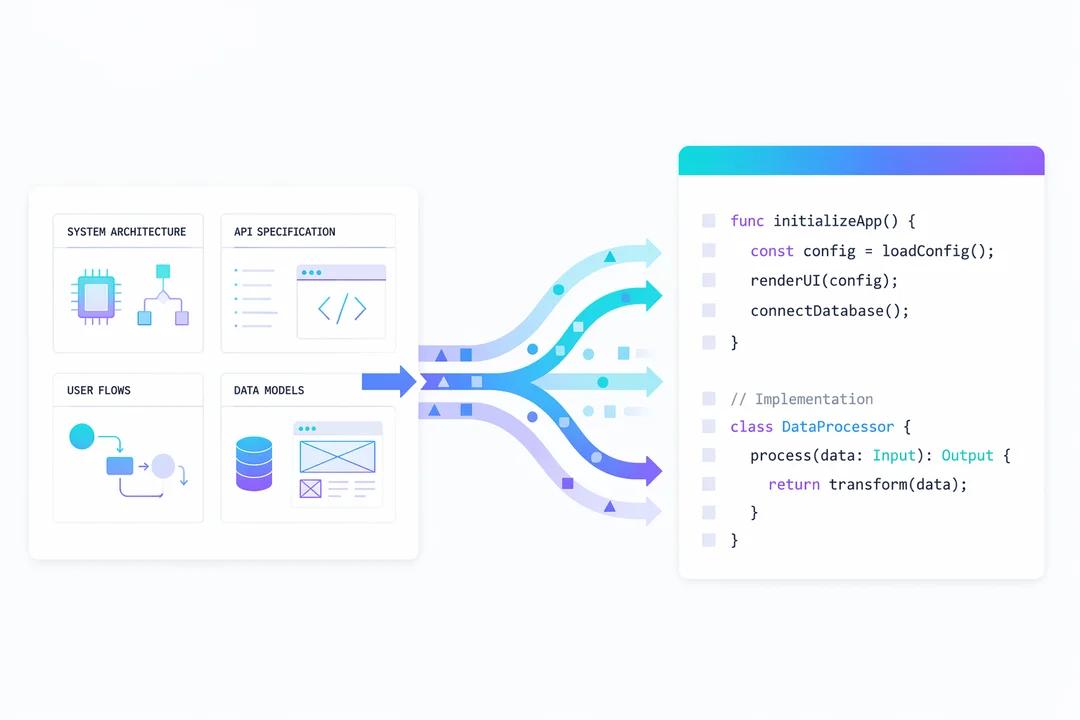
What is Spec-Driven Development (SDD) and Why Does It Matter?
Q: What is Spec-Driven Development (SDD) and why is it important?
A: Spec-Driven Development (SDD) is a software engineering methodology where a formal specification is written, reviewed, and agreed upon before any code is written. It matters because it makes the specification the single source of truth for every project decision. This eliminates ambiguity, prevents scope creep, and ensures developers (and AI assistants) build exactly what stakeholders actually need, rather than guessing based on vague requirements.
Most software projects fail not because developers can't code, but because nobody agreed on what to build. Spec-Driven Development (SDD) solves this by making specifications the absolute, centralized source of truth for every decision in your project—from architecture down to individual functions.
Here is a deep dive into what Spec-Driven Development is, why traditional coding methods fall short, and why SDD is crucial in the era of AI.
The Problem With Code-First Development
Traditional, code-first development often looks like this:
Someone has a vague idea.
The team jumps straight into coding.
Everyone hopes the result matches what stakeholders wanted.
Without a shared contract, this "shoot first, aim later" approach leads to three predictable failure modes:
Scope Creep: Without a strict boundary document, every conversation adds features. "While we are at it, can we add a dashboard?" becomes a routine phrase that derails timelines.
Misalignment: Developers interpret requirements differently than product managers intended. What a designer calls a "user profile," a database engineer might interpret as three different relational tables.
Rework Cycles: You discover what you actually needed only after building the wrong thing.
Data highlights how expensive this is. According to classic research by IBM's Systems Sciences Institute, fixing a bug or design flaw during the coding phase is 6.5 times more expensive than fixing it during the design phase—and up to 100 times more expensive if caught in production.
How Spec-Driven Development Works
Spec-Driven Development flips the traditional script. Instead of treating documentation as an afterthought, the specification becomes the actual product you build first. The code is simply the implementation of that spec.
A healthy SDD workflow involves three core phases:
1. Defining the Contract
Before opening an IDE, the team drafts a specification. For APIs, this might be an OpenAPI (Swagger) document. For frontend components, it might be a rigid Markdown file detailing state and UI behaviors.
2. Validating the Spec
Stakeholders, product managers, and developers review the document. Because it is much easier to read a JSON schema or a Markdown list than thousands of lines of React or Python, alignment happens in minutes rather than weeks.
3. Parallel Implementation
Once the spec is locked, frontend teams can build mock servers, backend teams can build the database logic, and QA can write test suites—all simultaneously, knowing the interfaces will match perfectly.
Why SDD Matters Even More in the Age of AI
AI-assisted development amplifies all the flaws of code-first development. Large Language Models (LLMs) can generate code faster than ever, but generating the wrong code faster doesn't help anyone.
When you feed an AI assistant a vague prompt, it guesses the underlying architecture. It hallucinates dependencies, ignores edge cases, and creates massive technical debt.
When you use Spec-Driven Development alongside AI:
You provide guardrails: The AI is forced to adhere to exact types, endpoints, and error codes defined in the spec.
You accelerate safely: Studies show that when developers use a "spec-first" prompt structure, LLM first-pass accuracy improves by up to 35%, drastically reducing the time spent debugging AI hallucinations.
Measurable Benefits of SDD
Organizations that transition from code-first to Spec-Driven Development experience significant improvements in engineering health:
Faster Time to Market: By parallelizing frontend and backend work against a shared contract, teams often cut delivery times by 20% to 30%.
Fewer Integration Bugs: Explicit dependencies and contract testing mean the "it works on my machine" excuse disappears.
Better Code Reviews: Pull requests are no longer debated on subjective opinions; code is simply verified against the spec.
Conclusion
Writing a specification before writing code might feel like it slows you down on day one. But as projects scale, teams grow, and AI generates thousands of lines of code per minute, SDD is the only way to maintain control. By agreeing on what to build before you build it, you save your team from the endless cycle of rework and misalignment.