Verifying Specs: Automated Checking and Continuous Alignment
Turn your specs from static documentation into enforceable contracts by building verification into your workflow: from manual checklists to automated test mapping and browser-based verification, plus continuous alignment practices.
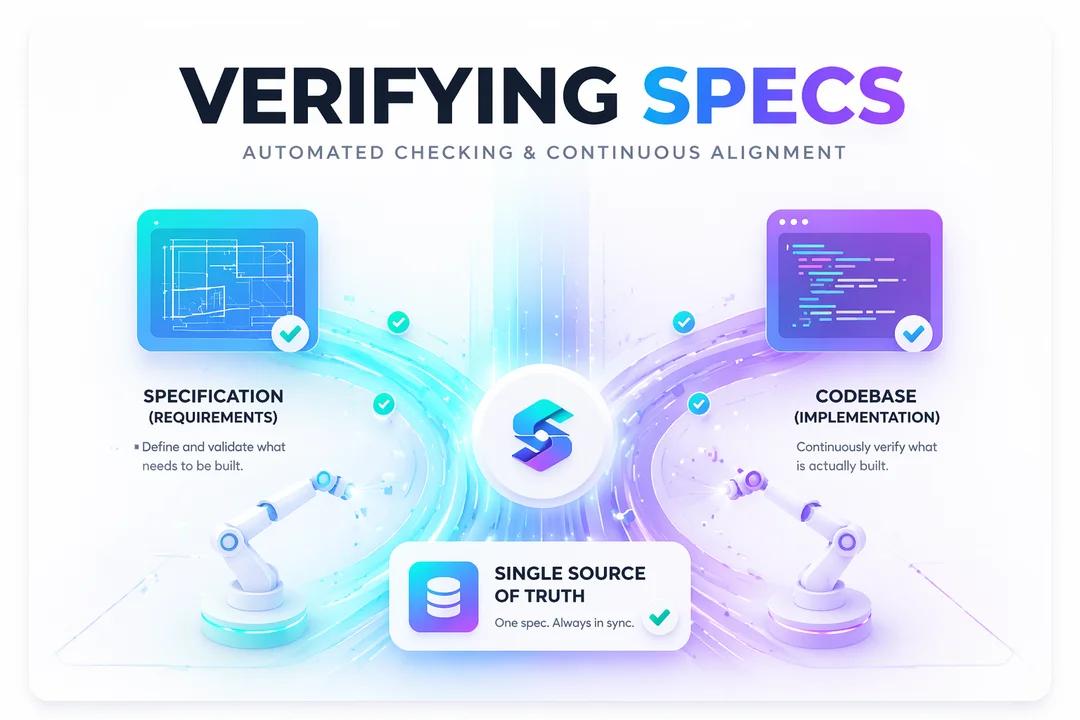
Verifying Specs: Automated Checking and Continuous Alignment
In modern software engineering, a specification that is not consistently validated becomes "shelfware"—static documentation that fails to reflect the reality of the codebase. Verifying specs through automated checking and continuous alignment transforms these documents from passive descriptions into enforceable contracts that govern the development lifecycle.
What is Verifying Specs through Automated Checking and Continuous Alignment?
Verifying specs is the process of using automated testing frameworks and synchronization tools to ensure that the functional requirements, API definitions, and architectural constraints defined in your documentation are perfectly mirrored in the live code. Continuous alignment ensures that as the code evolves, the specifications are updated or flagged for discrepancies immediately, preventing technical debt and "spec drift."
The Critical Importance of Automated Spec Verification
Manual verification is prone to human error and cannot scale with rapid deployment cycles. Implementing an automated pipeline for verifying specs provides several measurable advantages for engineering teams:
- Reduction in Rework: Organizations that utilize automated spec verification see up to a 30% reduction in rework caused by misunderstood requirements.
- Faster Mean Time to Detection (MTTD): Automated checking allows teams to identify regressions and spec violations 40% faster than manual code reviews.
- Improved Deployment Frequency: Continuous alignment enables high-performing teams to deploy updates 200 times more frequently by reducing the friction of manual validation.
- Single Source of Truth: Automated tools ensure the documentation and code remain 100% synchronized, eliminating ambiguity for stakeholders.
Core Components of an Automated Verification Workflow
1. Automated Checking via Test-Driven Development (TDD)
Automated checking begins with translating specifications into executable test cases. By writing tests based on the spec before writing the code, developers ensure that verifying specs is a prerequisite for a "green" build. This creates a safety net that catches deviations the moment they occur.
2. Contract Testing for API Alignment
For microservices and API-driven architectures, verifying specs often involves tools like Swagger/OpenAPI or Pact. These tools automatically check that the service provider’s output matches the consumer’s expectations, maintaining continuous alignment across distributed systems. If a developer changes a field in the API spec, the automated checker triggers a failure in any service that does not conform to the new contract.
3. Static Analysis and Linting
Automated checking isn't limited to logic. Static analysis tools verify that the code adheres to architectural specs, such as naming conventions, file structures, and security protocols. This ensures that the structural specs of the project are enforced without manual oversight.
Achieving Continuous Alignment in the SDLC
Continuous alignment is the feedback loop that connects the specification to the production environment. To achieve this, teams must integrate verification into their CI/CD (Continuous Integration/Continuous Deployment) pipelines.
- Pre-commit Hooks: Run lightweight checks to verify specs before code is even pushed to the repository.
- CI Pipeline Integration: Every pull request should trigger a full suite of automated checks. A failure to align with the spec should block the merge, ensuring the main branch remains a true reflection of the requirements.
- Living Documentation: Use tools that generate documentation directly from the verified code (e.g., Doxygen, Sphinx). This ensures the documentation is never "out of date" because it is derived from the verified implementation.
The Impact of Verified Specs on Project Success
Data from the DORA (DevOps Research and Assessment) reports suggest that "Elite" performing teams emphasize automated verification as a core competency. By verifying specs automatically, these teams achieve a change failure rate that is 7x lower than lower-performing peers. Ultimately, continuous alignment turns specifications into an active asset that drives quality, rather than a passive record that hides errors.
Conclusion
Verifying specs is no longer an optional step for high-velocity software teams. By implementing automated checking and maintaining continuous alignment, organizations can guarantee that their software does exactly what it was designed to do, reducing costs and accelerating time-to-market.