How Do You Use Spec-First AI Coding to Make LLMs Build What You Actually Want?
Spec-first AI coding replaces vague prompts and chaotic code generation with a simple workflow: clarify requirements, write a spec, then let the AI implement exactly what you approved.
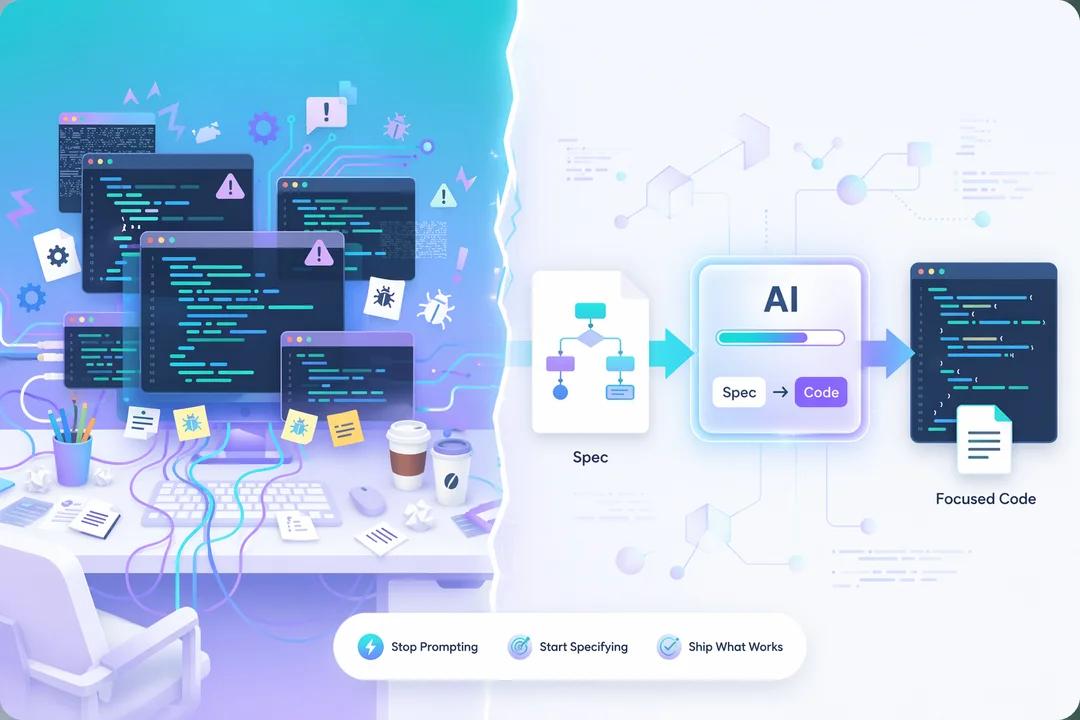
Q: What is Spec-First AI Coding?
A: Spec-first AI coding is a software development methodology where developers provide Large Language Models (LLMs) with a formal, structured specification (such as Markdown or OpenAPI) as the definitive source of truth, rather than relying on unstructured prompts. This approach flips the traditional AI dynamic: the human explicitly dictates what to build through the spec, and the AI determines how to build it.
The biggest failure mode in AI-assisted development today is letting the model decide what to build. When you toss a vague prompt at an LLM and hope for the best, you are handing over architectural control to a statistical engine.
Instead of treating your AI assistant like an oracle, you need to treat it like a junior developer. You do this by introducing a lightweight but powerful step: a shared specification that both you and the AI treat as the absolute source of truth.
The Vibe Coding Trap
Most developers using AI tools today follow a pattern known as "vibe coding." They write a rough paragraph describing a feature, hit generate, and blindly accept the output if it looks superficially correct.
This surface-level quality masks deeper architectural issues. Industry data highlights the stark reality of this approach:
Massive Refactoring: According to a 2025 survey by The New Stack, 76% of developers report having to rewrite or refactor at least half of AI-generated code before it is production-ready.
Higher Bug Rates: Recent code quality analyses show that AI-assisted pull requests contain 1.7x more issues than human-written ones.
Code Bloat: Without strict boundaries, LLMs frequently introduce duplicate logic, resulting in duplicate code rates jumping from 3.1% to over 14% in AI-heavy projects.
Vibe coding relies on the AI's internal assumptions. When an edge case isn't explicitly defined in your prompt, the LLM guesses—often resulting in missing timeouts, unhandled errors, and bloated dependencies.
The Mechanics of Spec-First AI Development
Spec-first coding solves the vibe coding trap by anchoring the LLM's context window to a rigid document. Here is how you can implement this methodology in your daily workflow.
Step 1: Write the Shared Specification
Before writing a single line of code or issuing a prompt, draft a specification document. This does not need to be a 50-page enterprise manual. It can be a simple Markdown file, an OpenAPI schema, or a structured JSON payload.
The spec should explicitly outline:
The exact input parameters and expected output formats.
Error handling requirements and HTTP status codes.
Required data structures and typing interfaces.
Step 2: Define Strict Constraints
LLMs are eager to please and will often import unnecessary third-party libraries just to solve a simple problem. Your prompt should pass the spec to the LLM alongside strict technical constraints.
Example Prompt: "Implement the API endpoint exactly as described in spec.yaml. You must use native Node.js fetch (no Axios). Do not add any dependencies not listed in package.json. Fail gracefully with a 500 error if the database connection times out after 3 seconds."
Step 3: Iterative Generation and Validation
Instead of asking the LLM to build the entire application at once, use the spec to generate code incrementally.
Ask the AI to generate the interface and type definitions based on the spec.
Ask the AI to generate unit tests that validate the spec.
Finally, ask the AI to write the implementation logic to make those tests pass.
Measurable Benefits of Spec-Driven LLM Coding
Shifting from prompt-based generation to spec-based generation yields immediate, measurable improvements to your codebase:
Drastically Reduced Hallucinations: When an LLM generates code against a strict interface specification, it has fewer opportunities to invent undocumented features or hallucinate incorrect API methods.
Improved First-Pass Accuracy: Research on "Self-Spec" methodologies in late 2025 demonstrated that forcing LLMs like GPT-4o to confirm and adhere to a structured specification before generating code improved pass rates significantly, jumping from 87% to 92% on standard benchmarks.
Easier Code Reviews: Reviewing AI-generated code is notoriously difficult because you have to guess what the AI was trying to achieve. With a spec-first approach, human reviewers simply compare the AI's output against the agreed-upon specification document.
Conclusion
AI coding tools are incredibly powerful, but they lack human intuition and architectural foresight. By adopting a spec-first AI coding methodology, you reclaim control over your codebase. You define the exact boundaries, behaviors, and data structures, allowing the LLM to do what it does best: generate boilerplate, syntax, and implementation logic with speed and precision. Stop vibe coding, and start writing specs.