Organizing Specs in Your Repository: File Structure and Git Workflow
A practical guide to structuring spec files in your repository, maintaining a spec index, naming conventions, and integrating specs into your Git workflow—including how to use specs effectively with AI coding tools.
Organizing Specs in Your Repository: File Structure and Git Workflow
As software teams grow, one of the most overlooked parts of spec-driven development is not writing specs—but organizing them properly inside your repository. Without a clear structure, even the best specs quickly become outdated, hard to find, or disconnected from the actual codebase.
This guide explains a simple, scalable way to organize product specs in your repo and align them with your Git workflow for smoother collaboration and faster development.
Why Spec Organization Matters
Writing a spec is only the first step. Without proper spec organization, even the best product specification document quickly loses value. If teams can’t easily find, understand, or trust a software requirements specification (SRS), it stops being useful in the product development workflow.
A well-structured system turns specs from static documents into reliable blueprints. It improves team alignment, speeds up development, enhances code quality, and ensures consistency across features. More importantly, in modern AI-assisted development, clean specs significantly improve output accuracy—because AI tools rely heavily on structured, unambiguous inputs.
In short, better spec management leads to faster delivery with fewer mistakes.
A Scalable Way to Organize Specs
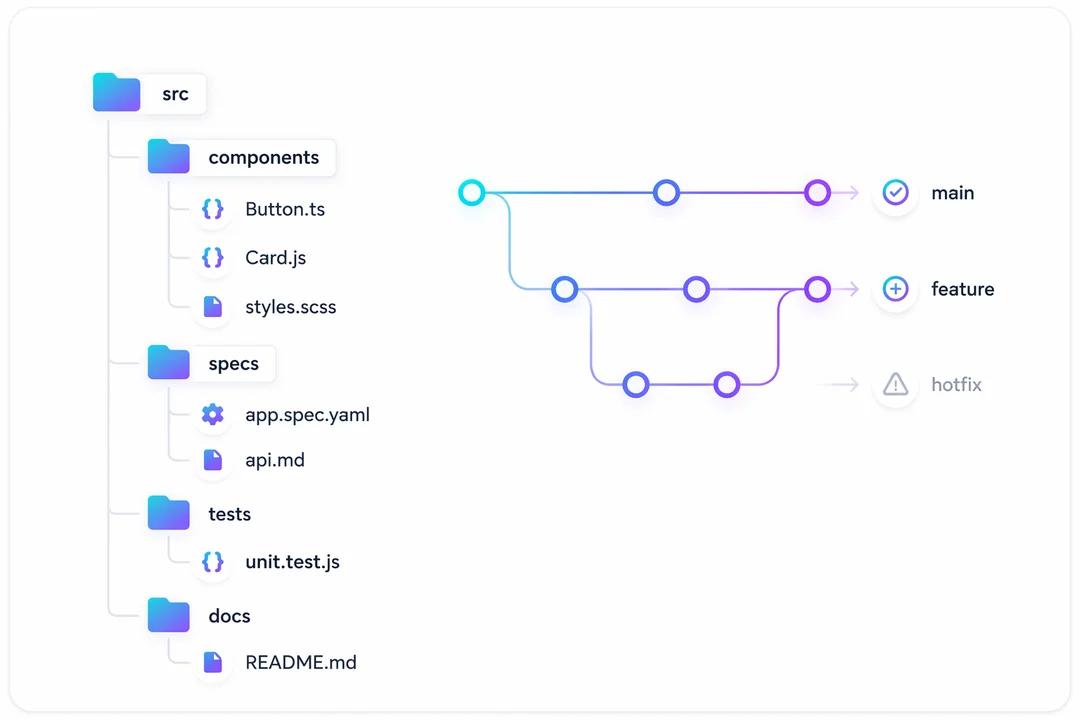
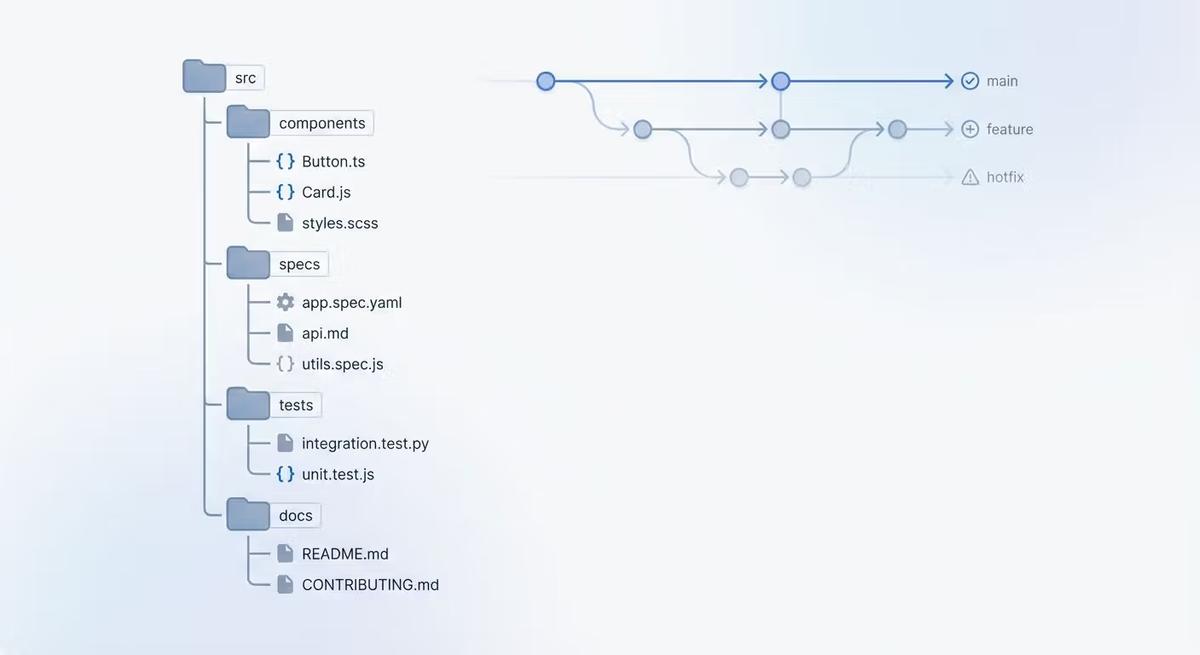
The most effective approach is to organize your technical specifications by feature. Instead of storing everything in one place, each feature should have its own dedicated folder within your repository.
Inside that folder, break the spec into smaller, focused documents—such as the main overview, acceptance criteria, and technical notes. This structure keeps everything related to a feature in one place, making it easier for developers to navigate without jumping across multiple tools.
This approach also improves onboarding. New team members can understand a feature end-to-end by reviewing a single location, rather than piecing together information from scattered sources. As your product scales, this kind of spec-driven development structure becomes critical for maintaining clarity and speed.
What Each Spec Section Should Include
A strong software spec template avoids long, messy documents by breaking content into clear sections with specific purposes.
The main spec overview explains the problem, the goal of the feature, and the user flow. It also defines scope—what is included and what is not. This ensures everyone understands what is being built and why, which is essential for reducing product requirement gaps.
The acceptance criteria are the most important part of any functional specification. They define what success looks like in a way that is observable and testable. Clear criteria remove ambiguity, making it easier for developers to implement, QA to validate, and AI tools to generate accurate outputs.
Technical notes should only be included when necessary. This section provides context around constraints such as APIs, data sources, performance expectations, or integrations. It supports implementation without turning the spec into a low-level design document.
Managing Specs with Git Workflow
A modern requirements management process treats specs as living documents that evolve alongside the product. Using a structured Git workflow ensures your product requirement document (PRD) stays aligned with development.
Start by creating a dedicated branch for the spec before any coding begins. This allows teams to review and refine requirements early. Once ready, run a spec review process involving product managers, developers, and QA to validate business logic, feasibility, and testability.
After approval, development moves to a separate branch, with clear linkage between the spec and implementation. If requirements change during development, update the spec first before modifying the code. This prevents drift and keeps documentation reliable—a common challenge in software development.
Best Practices for Spec Management
Effective spec management best practices focus on clarity, consistency, and maintainability. Each feature should remain self-contained, with consistent naming conventions across all documents. Specs should be treated as living assets that evolve over time, not static files that quickly become outdated.
It’s also critical to maintain traceability—every major code change should link back to a defined requirement. This improves accountability and ensures your software requirements specification continues to reflect actual product behavior.
How This Improves AI-Assisted Development
As AI in software development becomes more common, the quality of your specs directly impacts output quality. Well-structured specs enable AI tools to generate more accurate code, reduce incorrect assumptions, and produce better test cases.
When your technical specification is clear and organized, AI can follow intended logic and architecture more reliably. This makes spec quality a key lever for improving productivity in AI-powered workflows.
Instead of starting from a blank page, you can use myspec —an AI-powered agent designed to guide you step-by-step and turn your ideas into a complete, high-quality spec ready for review and development.
👉 Try myspec to:
- Generate structured product requirement documents (PRDs)
- Define clear, testable acceptance criteria
- Catch edge cases early
- Create better specs for building websites and products with AI
Because better specs don’t just make development easier—they make great products possible.