How Spec-Driven Development Helps Enterprise Scale
How to scale Spec-Driven Development across multiple teams, repos, and products using interface specs, explicit dependencies, lightweight review, and clear metrics.
How Spec-Driven Development Helps Enterprise Scale
In the world of enterprise software, Spec-Driven Development (SDD) is evolving from a niche methodology into a strategic necessity. SDD requires that a technical specification—like an OpenAPI, AsyncAPI, or GraphQL schema—is created before any code is written. While this approach is effective in small teams, scaling it to an enterprise scale demands a fundamental shift from informal agreements to a system of rigorous, automated governance that spans multiple departments. This structured approach is not just about better documentation; it's about creating a predictable, scalable, and efficient development ecosystem.
As AI continues to reshape software development, the focus is shifting from the act of writing code to the art of defining clear, machine-readable specifications. In this new paradigm, humans define the "what" (functional goals) and the "how" (architectural rules and standards), while AI handles the heavy lifting of code generation. This synergy makes Spec-Driven Development a critical enabler for scaling AI development teams and standardizing AI code generation.
How to Scale Spec-Driven Development for Enterprise Success
To effectively implement spec-driven development at an enterprise level, organizations must establish a framework that prioritizes clarity, consistency, and automation. The goal is to treat specifications as the "single source of truth" for all internal and external integrations, which is essential for managing complexity at an enterprise scale.
This is achieved by implementing three core pillars:
A Centralized Schema Registry: This acts as a universal repository for all data contracts, preventing redundant work and ensuring consistency.
Automated Contract Testing: By embedding validation directly into CI/CD pipelines, teams can catch breaking changes before they disrupt the ecosystem.
A Federated Governance Model: This model empowers individual teams to contribute to and evolve specifications while adhering to global enterprise software specification standards.
Key Challenges of SDD at an Enterprise Scale
As organizations expand, several obstacles can undermine the effectiveness of SDD if not addressed proactively:
Schema Fragmentation: Without a central authority, different teams may create conflicting or overlapping definitions for the same data entities, leading to integration chaos.
Version Drift: It becomes increasingly difficult to keep specifications synchronized with the actual code implementation across a sprawling architecture of microservices.
Coordination Overhead: The time required for cross-team reviews and approvals can introduce significant delays, slowing down the development lifecycle.
Strategies for Efficiently Scaling SDD
1. Centralized Schema Management
At an enterprise scale, manually sharing YAML or JSON files is unsustainable. A centralized Schema Registry (such as Confluent Schema Registry, Apollo Studio, or SwaggerHub) is crucial. It serves as a single source of truth, allowing teams to discover and reuse existing specifications. This practice reduces duplicate work, enforces naming consistency, and streamlines data governance across the organization.
2. Automated Contract Testing
Automation is the linchpin of scaling SDD. Contract testing is a technique that verifies the interactions between services to ensure they communicate correctly. By integrating tools like Pact or Prism into the CI/CD pipeline, organizations can automatically validate that the code implementation adheres to its specified contract. This proactive validation can reduce integration bugs by up to 40% by identifying breaking changes before they reach production environments.
3. "Spec-First" Governance and Standardizing AI Code Generation
A formal governance model ensures that all specifications align with organizational standards. This can be managed by a "Design Review Board" or, more efficiently, through automated linters like Spectral. By enforcing linting rules at the commit level, teams can maintain high-quality documentation without manual oversight.
This governance is particularly vital for standardizing AI code generation. When specifications are consistent and high-quality, AI coding agents can generate reliable, compliant, and predictable code, transforming development from a manual task into a supervised, automated process. This structured approach empowers AI with the necessary context to adhere to corporate standards, such as using specific APIs or testing frameworks.
The Quantitative Impact of Scaling SDD
Adopting a mature SDD model at an enterprise scale delivers significant and measurable business value:
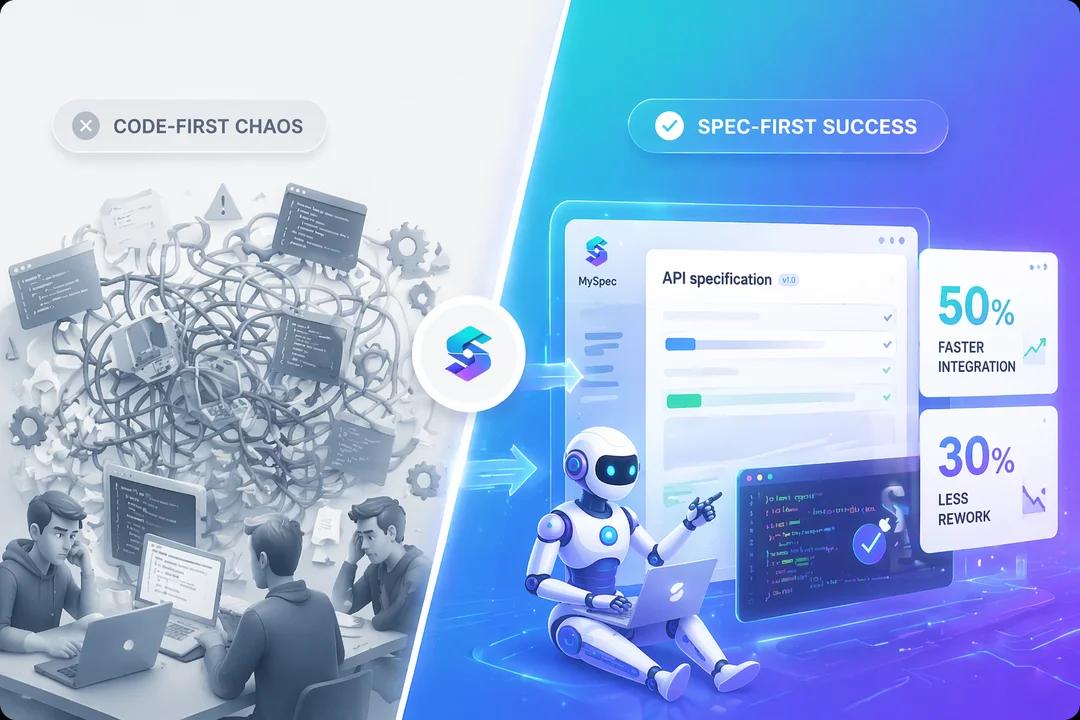
50% Faster Integration: Industry benchmarks show that teams employing spec-first methodologies can reduce the time-to-first-call by half when compared to code-first approaches.
30% Reduction in Rework: By standardizing specifications early in the design phase, costly architectural changes are prevented later in the development cycle.
25% Increase in Developer Productivity: Large enterprises report a significant boost in productivity when documentation is automatically generated from specifications and is always up-to-date.
Best Practices for Maintaining SDD at Enterprise Scale
To ensure the long-term success of spec-driven development in an enterprise setting, follow these tactical steps:
Establish a Unified Language: Adopt a common Domain-Driven Design (DDD) approach. This ensures that a term like "User ID" has a consistent meaning across the billing, shipping, and user management services, preventing semantic errors that can cause integration failures at scale.
Modularize Specifications: Avoid monolithic spec files. Instead, break them down into smaller, reusable components and shared libraries. This allows teams to import common objects (e.g., error schemas, pagination headers), ensuring consistency while permitting individual services to evolve independently.
Invest in Developer Tooling: Equip teams with tools that automate the creation of server stubs and client SDKs directly from specifications. This "spec-to-code" automation accelerates initial setup and ensures developers build within the guardrails defined by the enterprise software specification standards.
Conclusion
Successfully scaling Spec-Driven Development is about more than just adopting new tools; it requires building a culture where the specification is treated as the primary product. By focusing on centralized registries, automated validation, and clear governance, organizations can unlock higher velocity and greater reliability, even as they navigate the growing complexity of an enterprise scale architecture. This structured approach is the key to managing today's intricate systems and paving the way for a future of standardized, AI-driven development.
Instead of starting from a blank page, you can use myspec —an AI-powered agent designed to guide you step-by-step and turn your ideas into a complete, high-quality spec ready for review and development.
👉 Try myspec to:
- Generate structured product requirement documents (PRDs)
- Define clear, testable acceptance criteria
- Catch edge cases early
- Create better specs for building websites and products with AI
Because better specs don’t just make development easier—they make great products possible.