Software Requirements Specification (SRS): How to Write Better Requirements for AI Development
Learn what a Software Requirements Specification (SRS) is, what it should include, and how to write clear, actionable requirements for modern software development. Explore how SRS is evolving in the age of AI coding and why structured specifications are becoming essential for turning product ideas into build-ready software.
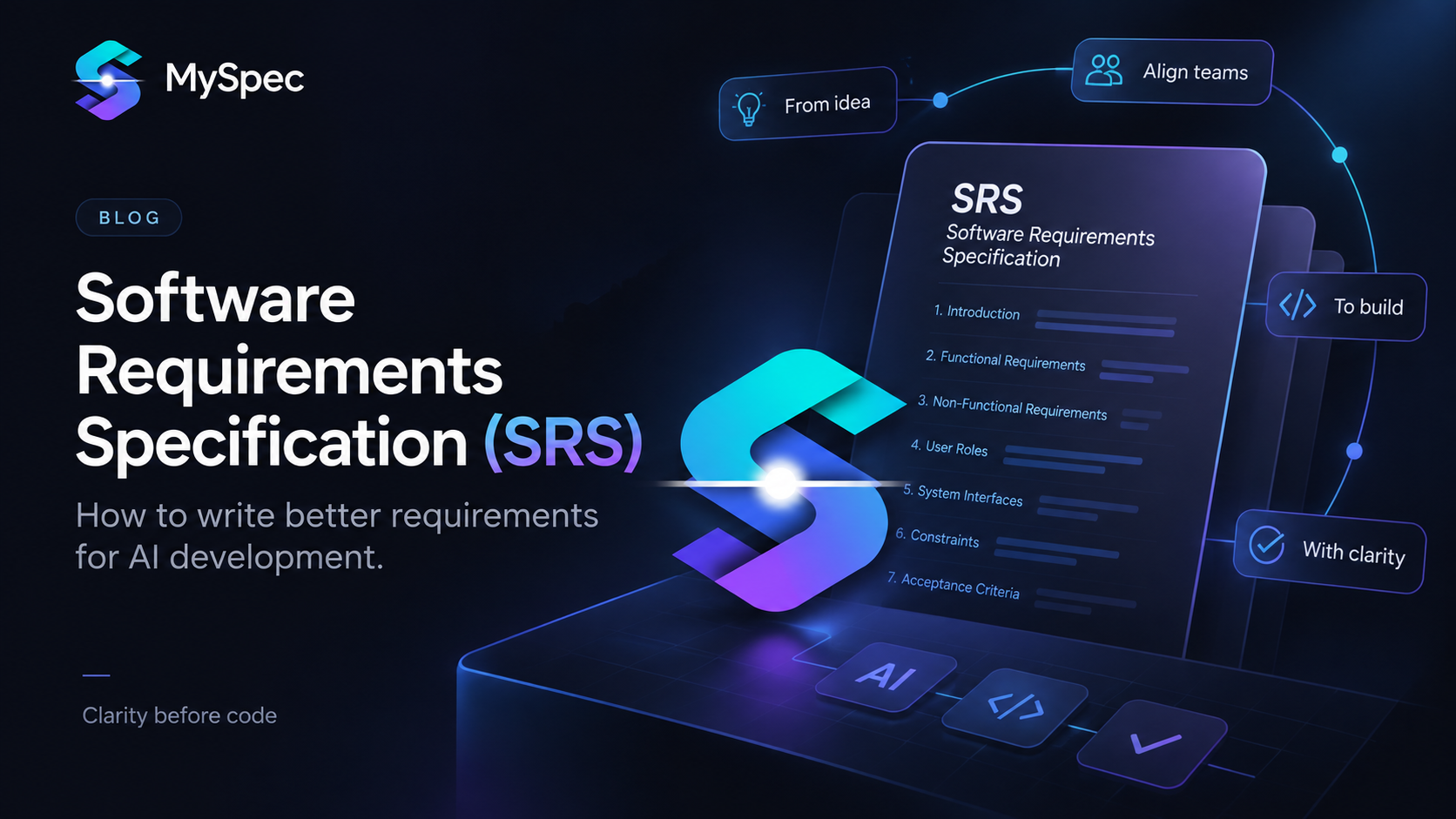
Building software often starts with something surprisingly vague.
“We need a dashboard for our customers.”
“Users should be able to manage their subscriptions.”
“Let's build an internal tool for the operations team.”
These statements might be enough to communicate an idea, but they are rarely enough to build reliable software. Developers still need to decide how the system should behave, which users can perform which actions, what happens when something fails, what constraints must be respected, and how success should be measured.
This is where a Software Requirements Specification (SRS) becomes valuable.
An SRS turns product intent into a structured description of what a software system needs to do and the conditions under which it should operate. It creates a shared reference for product managers, developers, QA engineers, architects, stakeholders, and increasingly, AI coding agents.
As AI becomes more involved in software development, that role becomes even more important. AI can generate code quickly, but it still needs clear context and constraints to generate the right code.
What Is a Software Requirements Specification (SRS)?
A Software Requirements Specification, commonly shortened to SRS, is a structured description of the requirements for a software system.
ISO/IEC/IEEE 29148 defines a software requirements specification as a structured collection of essential software requirements covering areas such as functions, performance, design constraints, attributes, and external interfaces.
In practical terms, an SRS answers questions such as:
- What problem is the software solving?
- Who will use the system?
- What should users be able to do?
- How should the system respond to different situations?
- What performance, security, reliability, and usability expectations exist?
- What external systems or interfaces does the product depend on?
- What constraints must the implementation respect?
- How do we determine whether a requirement has been successfully implemented?
Instead of relying on conversations, scattered tickets, prompts, and assumptions, teams create an explicit reference for what they intend to build.
Why Is an SRS Important?
The problem an SRS solves is not simply missing documentation. It is ambiguity.
A stakeholder may say that a page should load “quickly.” A developer needs to know what quickly means.
A product manager may ask for “secure authentication.” An engineer needs to know which authentication methods are supported, what authorization rules apply, how sessions behave, and what security constraints must be satisfied.
A requirement might say:
Users should be able to find projects easily.
That sounds reasonable, but it leaves several implementation decisions unanswered.
A stronger requirement might specify:
Authenticated users can search projects by name and filter results by status and owner. Search results should update within one second for workspaces containing up to 10,000 projects.
Now developers know what behavior is expected, QA engineers have something measurable to test, and stakeholders can verify whether the implementation matches their intent.
The SRS therefore becomes a common reference point between business intent and technical implementation.
What Should an SRS Include?
The exact structure of a Software Requirements Specification depends on the project, but a useful SRS normally captures several categories of information.
1. Purpose and Scope
Start by defining what the software is intended to accomplish.
This section should explain the problem, target users, product objectives, system boundaries, and anything explicitly outside the project's scope.
For example:
Product: Remote Team Manager
Purpose: Help distributed teams manage projects, assign work, and track progress from one workspace.
Primary users: Team members, project managers, and workspace administrators.
A clear scope prevents requirements from expanding silently as development progresses.
2. Functional Requirements
Functional requirements describe what the software must do.
Examples include:
- Users can create an account and sign in.
- Project managers can create and archive projects.
- Managers can assign tasks to team members.
- Team members can update the status of assigned tasks.
- Users can search and filter tasks.
- Administrators can manage workspace permissions.
Good functional requirements should describe observable behavior rather than vague intentions.
Instead of:
The system should provide task management.
Specify:
A project manager can create a task containing a title, description, assignee, priority, due date, and status.
The second requirement gives developers and testers something concrete to work with.
3. Non-Functional Requirements
Non-functional requirements describe how well the system should operate rather than which features it provides.
Typical areas include:
Performance: How quickly should requests or pages respond?
Scalability: How many users, requests, or records should the system support?
Security: How should authentication, authorization, encryption, and sensitive data be handled?
Reliability: What level of uptime or fault tolerance is required?
Usability: What accessibility or usability standards should be followed?
Maintainability: Are there architectural or engineering constraints that make the system easier to maintain?
For example:
95% of API requests should complete within 500 milliseconds under normal operating load.
This is much more useful than saying:
The API should be fast.
4. User Roles and Permissions
Many software products behave differently depending on who is using them.
An SRS should therefore define the major roles and what each role is allowed to do.
For a project management application, this might include:
Administrator: Manages workspace settings, users, and permissions.
Project Manager: Creates projects, assigns tasks, and manages project workflows.
Team Member: Views assigned work and updates task progress.
Explicit permission boundaries help prevent both product ambiguity and security problems later in development.
5. System Interfaces and Dependencies
Modern applications rarely operate independently.
Your SRS should identify important external dependencies, including APIs, databases, authentication providers, payment services, third-party integrations, external data sources, and communication services.
For example, a SaaS product might depend on Stripe for payments, Google OAuth for authentication, and SendGrid for transactional email.
Defining these dependencies early helps teams understand the system boundary before implementation begins.
6. Constraints and Assumptions
Not every technical decision is open-ended.
A project might need to support an existing database, comply with a regulatory requirement, run within a specific cloud environment, integrate with a legacy API, or remain compatible with an existing application.
These constraints should be documented explicitly.
Otherwise, developers or AI coding tools may make technically reasonable decisions that conflict with the actual environment.
7. Acceptance Criteria
Requirements become significantly more useful when teams can determine whether they have actually been satisfied.
For example:
Requirement: Users can reset a forgotten password.
Acceptance criteria:
- A user can request a reset using their registered email address.
- The system sends a time-limited reset link.
- An expired link cannot be used.
- After successfully changing the password, the previous password no longer works.
Acceptance criteria connect requirements directly to implementation and testing.
Functional vs. Non-Functional Requirements
One of the most important distinctions when writing an SRS is between functional and non-functional requirements.
Functional requirements describe what the system does.
Examples include creating an account, uploading a document, processing a payment, assigning a task, or generating a report.
Non-functional requirements describe the quality or operating conditions of those functions.
Examples include response time, availability, scalability, accessibility, security, reliability, and maintainability.
Consider an authentication system.
A functional requirement might state:
Users can sign in using email and password.
A corresponding non-functional requirement could state:
Passwords must be stored using an approved one-way password hashing algorithm.
A system can technically implement every requested feature and still provide a poor product if its non-functional requirements are ignored. Both categories therefore belong in a useful Software Requirements Specification.
What Makes a Good Software Requirement?
Writing more requirements does not automatically produce a better SRS.
The quality of individual requirements matters.
A useful requirement should be clear enough that different people can read it and reach approximately the same interpretation. It should also be necessary, feasible, consistent with other requirements, and verifiable.
Compare these two examples:
Weak requirement:
The dashboard should be user-friendly and fast.
Better requirement:
After authentication, the dashboard should display the user's active projects, tasks due within seven days, and overdue tasks. Under normal load, the dashboard should become interactive within two seconds.
The first statement communicates an intention.
The second creates something that designers can design around, developers can implement, and QA engineers can verify.
How to Write an SRS Step by Step
Creating an SRS should not begin by immediately filling out a document template.
The first step is understanding the intent behind the product.
Step 1: Understand the Problem
Start with the reason the software needs to exist.
What problem are users experiencing? Who experiences it? What outcome should the product create?
This context helps prevent teams from documenting features that do not actually contribute to the product's objective.
Step 2: Identify Stakeholders and Users
Different stakeholders often have different expectations.
Founders may care about time to market. Users care about usability. Developers care about technical feasibility. QA engineers need measurable behavior. Security teams care about risk and compliance.
Requirements should reconcile these perspectives rather than representing only one of them.
Step 3: Define Scope and Boundaries
Decide what belongs in the system and what does not.
Clear boundaries reduce scope creep and prevent developers from making assumptions about functionality that has not actually been approved.
Step 4: Capture Functional Requirements
Describe the behaviors the system must support.
Where possible, organize them around user workflows rather than producing a disconnected feature list.
Step 5: Define Non-Functional Requirements
Specify expectations around performance, security, reliability, scalability, accessibility, compatibility, and maintainability.
Whenever possible, make them measurable.
Step 6: Add Constraints and Dependencies
Document technical limitations, external integrations, platform requirements, business rules, and assumptions that affect implementation.
Step 7: Define Acceptance Criteria
Determine how each important requirement will be validated.
This gives developers and QA teams a shared definition of completion.
Step 8: Review Requirements Before Implementation
Requirements should not be treated as correct simply because they have been written down.
Stakeholders, product teams, engineers, architects, and QA should review important decisions before development begins.
Look specifically for ambiguity, contradictions, missing edge cases, hidden assumptions, and requirements that cannot be tested.
SRS in the Age of AI Coding
The rise of AI coding tools changes how software is implemented, but it does not eliminate the need for requirements.
In many cases, it makes them more important.
AI coding agents can generate components, APIs, database schemas, tests, and even substantial applications from natural-language instructions. But their output depends heavily on the context they receive.
A prompt such as:
Build a project management app for remote teams.
leaves hundreds of decisions unspecified.
Which roles exist? Who can create projects? Can users belong to multiple workspaces? How are permissions inherited? What happens when a user is removed? Are archived projects searchable? What performance constraints exist? What happens to historical task data?
An AI system will still need to make decisions.
If those decisions are not provided explicitly, they become assumptions.
This creates a new version of an old software engineering problem: instead of developers interpreting incomplete requirements differently, AI agents may generate different implementations from incomplete prompts.
The bottleneck therefore moves upstream.
Writing code becomes faster. Defining what should be built becomes more important.
From SRS to Spec-Driven Development
Traditional SRS documents are useful, but modern software development often requires more than one static requirements document.
Requirements connect to product principles. Requirements influence architecture. Architecture determines implementation tasks. New decisions modify existing requirements.
This is the idea behind Spec-Driven Development.
Instead of treating specifications as documentation created before development and forgotten afterward, specifications become part of the development workflow itself.
A typical flow might look like:
Intent → Requirements → Solution → Tasks → Implementation
When a requirement changes, the corresponding technical decisions and implementation plan can be reviewed as well.
This is especially useful when AI coding agents are involved because the agent receives structured context instead of a sequence of disconnected prompts.
Creating Software Requirements with MySpec
MySpec is built around this specification-first approach.
Instead of starting with an empty SRS template, you can describe what you want to build and work through a structured discovery process.
MySpec helps turn that initial intent into requirements and other connected specifications that can be reviewed before implementation.
For a new project, the workflow can move from initial product context through requirements and solution design to actionable implementation tasks.
For an existing codebase, MySpec can analyze the current system and help define proposed changes in the context of what already exists.
Each stage can be reviewed, changed, and approved rather than treating AI-generated output as automatically correct.
Once the specifications are ready, they can provide structured context for development tools and AI coding agents such as Claude Code, Codex, Cursor, Copilot, Lovable, Bolt, and Replit.
The objective is not simply to generate a longer requirements document.
It is to make the decisions behind the software explicit before those decisions become code.
SRS Template
A simple Software Requirements Specification can follow this structure:
1. Introduction
- Purpose
- Product overview
- Goals
- Scope
- Definitions
2. Users and Stakeholders
- User roles
- Stakeholder needs
- Permissions
3. Functional Requirements
- Features
- User workflows
- Business rules
- Inputs and outputs
- Error scenarios
4. Non-Functional Requirements
- Performance
- Security
- Scalability
- Reliability
- Accessibility
- Maintainability
5. Interfaces and Dependencies
- External APIs
- Third-party services
- Data sources
- System integrations
6. Constraints and Assumptions
- Technical constraints
- Business constraints
- Platform requirements
- Assumptions
7. Acceptance Criteria
- Expected behavior
- Validation conditions
- Success criteria
8. Open Questions
- Unresolved decisions
- Risks
- Dependencies requiring confirmation
The important part is not following a template perfectly. The goal is to capture enough structured information that the people, and AI systems, implementing the product do not need to guess what you meant.
Final Thoughts
A Software Requirements Specification (SRS) has always helped bridge the gap between a product idea and its implementation.
That gap does not disappear when AI writes the code.
If anything, faster implementation makes unclear requirements more expensive. An AI agent can produce the wrong solution much faster than a traditional development process can.
The advantage therefore shifts toward teams that can define intent clearly, expose assumptions early, review important decisions, and maintain requirements as the product evolves.
A good SRS provides that foundation.
And when requirements, architecture, tasks, and implementation remain connected, the specification becomes more than documentation. It becomes part of how the software is built.
With MySpec, you can start from an idea or an existing codebase, turn it into structured, reviewable specifications, and carry that context into the AI development tools you already use.